Greece Area Guide: Complete Overview for Property Buyers
From Athens's vibrant neighbourhoods to the Cycladic islands, the Ionian coast and Crete, this comprehensive overview covers Greece's regions, property types, buying process and Golden Visa programme for UK buyers.

Greece at a Glance: Geography, Climate and Character
Greece occupies the southernmost tip of the Balkan Peninsula, extending into the eastern Mediterranean with a coastline stretching over 13,600 kilometres — one of the longest in the world. The country is defined as much by its sea as its land: roughly 6,000 islands and islets are scattered across the Ionian, Aegean and Mediterranean seas, of which around 230 are permanently inhabited. This extraordinary geographic diversity — mainland mountain ranges, fertile plains, volcanic island chains, sheltered harbours and open ocean — creates a property market of remarkable variety, where the character of a location changes fundamentally within a few hours' drive or a short ferry crossing.
Greece's climate is predominantly Mediterranean — dry, warm summers and mild, wet winters in coastal regions — though significant variation exists between the northern mainland, which experiences colder continental winters, the Cycladic islands with their intense summer heat and famous Meltemi winds, and the Ionian islands, which benefit from higher rainfall and a lush green landscape that sets them apart visually from the volcanic austerity of the Aegean. For buyers considering a property purchase, understanding the micro-climate of a specific location is as important as understanding its macro-geography.
The population of approximately 10.5 million is concentrated primarily in Athens, which accounts for around 3.7 million people and functions as the country's dominant commercial, cultural and transport hub. Thessaloniki in the north is the second city, with a character distinctly its own — more cosmopolitan, more European in flavour, less visited by international tourists but increasingly attractive to buyers seeking urban lifestyle at lower price points than the capital.
A Nation Shaped by History
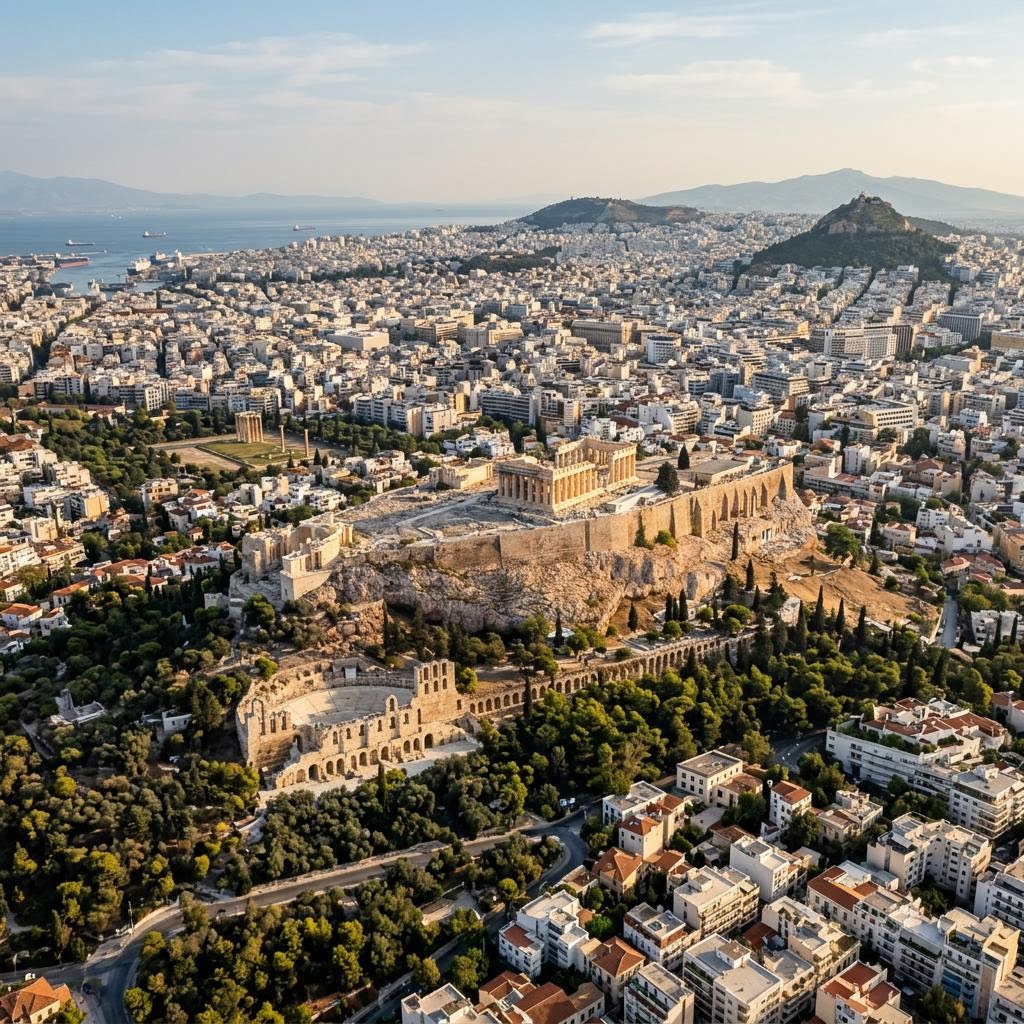
Greece's significance to Western civilisation cannot be overstated, and that history is present in the landscape in a way that is entirely unique. Athens is home to the Acropolis — the most photographed ancient monument in Europe — and its surrounding archaeological sites, museums and neoclassical architecture form a cultural context that shapes the experience of living in or visiting the city in ways that no other European capital can replicate. The Parthenon is not a distant heritage site: it is visible from apartment terraces, from hotel rooftops, from café tables across central Athens. It is part of daily life.
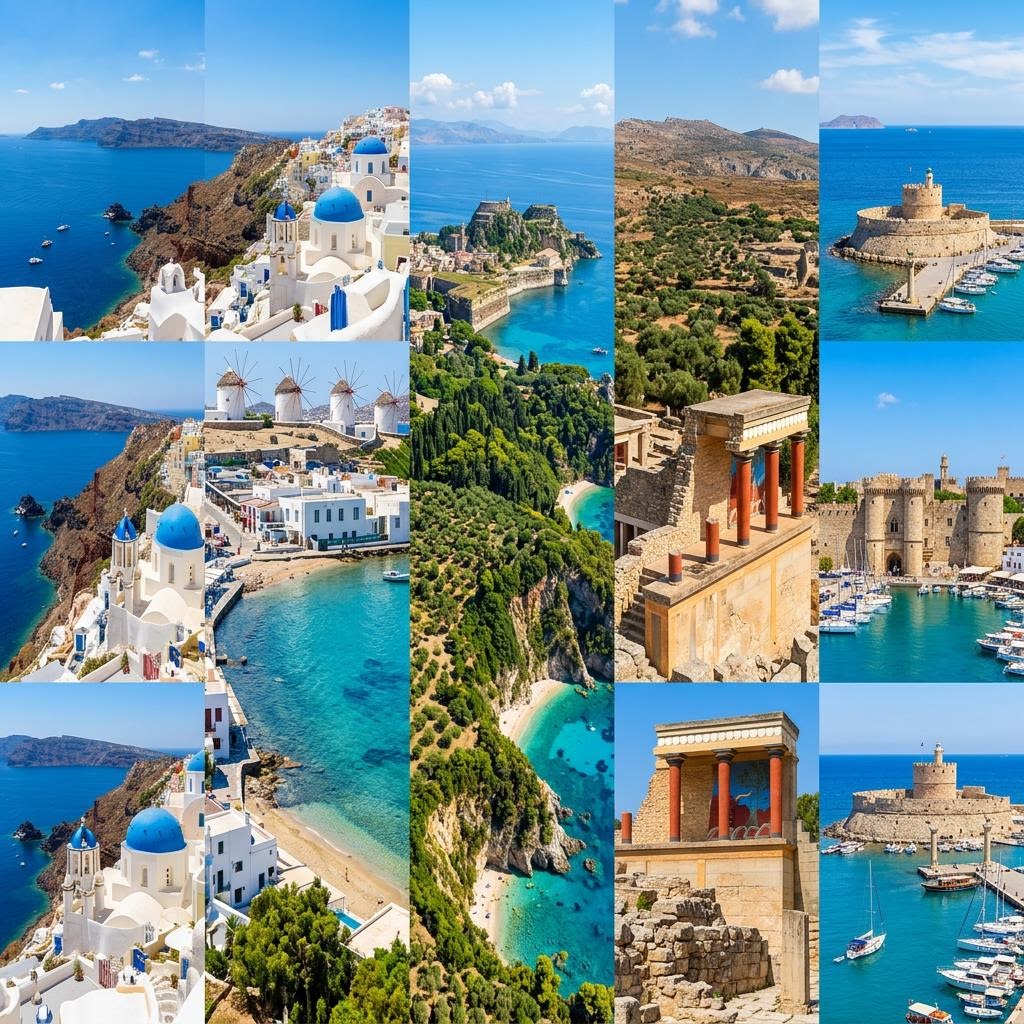
Beyond Athens, Greek history is literally underfoot across the entire country. Delphi, Olympia, Mycenae, Knossos, Rhodes Old Town, Corfu's Venetian fortifications, the Byzantine monasteries of Meteora — Greece's historical layering spans Minoan, Mycenaean, Classical, Hellenistic, Roman, Byzantine, Ottoman and Venetian periods, creating a palimpsest of civilisation that gives the country a cultural depth that draws visitors, scholars and buyers from around the world. For property buyers, proximity to this heritage — and the tourism it generates — is a structural feature of the market rather than a nice-to-have.
The Athens Property Market
Athens represents the most liquid and diversified property market in Greece, offering the full spectrum from compact city-centre studios to neoclassical mansions, modern high-rise penthouses and the sprawling villa developments of the Athenian Riviera stretching south along the coast towards Vouliagmeni and Varkiza. The capital's appeal to international buyers has grown substantially since 2018, driven by the Golden Visa programme's investment threshold, the rapid development of short-term rental infrastructure, and Athens's emergence as a genuine city-break and cultural tourism destination rather than merely a gateway to the islands.
Key residential neighbourhoods for buyers include: Kolonaki, the established premium district adjacent to Syntagma Square, characterised by neoclassical architecture, high-end retail and proximity to the National Gallery and Lycabettus Hill; Koukaki and Plaka, the historic neighbourhoods immediately below the Acropolis, now among the most sought-after short-term rental locations in Europe; Glyfada and the Athenian Riviera, offering a coastal lifestyle within 25 minutes of the city centre, with a growing community of British, American and Gulf-based residents; and Exarcheia and Monastiraki, attracting a younger, more design-led buyer profile as part of the city's ongoing gentrification.
Athens's property prices remain among the most attractive of any European capital when adjusted for lifestyle quality, infrastructure and global name recognition. The combination of relatively affordable acquisition costs, strong short-term rental demand, an improving public transport network and a year-round cultural programme makes Athens one of the most compelling urban property propositions in Southern Europe for British buyers. For those specifically considering city-centre apartments, our apartments for sale in Greece guide provides detailed investment context across Athens and the islands.
The Greek Islands: An Overview
Greece's island groups — the Cyclades, the Dodecanese, the Ionian Islands, the Sporades, the Saronic Gulf islands and the North Aegean islands — each have a distinct character, climate, infrastructure profile and property market dynamic. Understanding which island group, and which island within it, aligns with a buyer's lifestyle or investment objectives is the most important initial decision in any Greek island property search.
The Cyclades — the archipelago stretching across the central Aegean, anchored by Santorini and Mykonos — represent the global pinnacle of Greek island aspiration. These islands are characterised by the iconic whitewashed Cycladic architecture, the intense blue of the Aegean, dramatic volcanic geology and a premium price point that reflects their worldwide recognition. Santorini's caldera setting is one of the most photographed landscapes on earth; Mykonos's global reputation for luxury tourism and nightlife draws high-net-worth visitors from every continent. Property values on these two islands have risen consistently and significantly, driven by a combination of supply constraint and sustained international demand.
The Ionian Islands — Corfu, Kefalonia, Zakynthos, Lefkada and their smaller neighbours — offer a markedly different character: lush green landscapes shaped by higher rainfall, Venetian-influenced architecture in their principal towns, calmer seas on the western coast, and a more established British buyer community than most Aegean destinations. Corfu in particular has attracted British purchasers for several decades, and a well-developed infrastructure of English-speaking professionals — lawyers, estate agents, architects and builders — supports buyers through the acquisition process. Kefalonia and Zakynthos offer lower entry prices than Corfu with comparable natural beauty, making them attractive for buyers seeking island lifestyle at more accessible capital commitments.
Crete — technically the largest of all Greek islands and large enough to function almost as a country within a country — merits separate consideration. Its scale supports genuine year-round residential life in its cities (Heraklion, Chania, Rethymno), a mature tourism economy with two international airports, diverse landscape spanning rugged mountain ranges and one of the Mediterranean's finest coastlines, and a property market that spans every category from compact city apartments to large estate properties. Crete's combination of scale, infrastructure and relative value compared to the Cycladic premium tier makes it one of the most compelling long-term property destinations in Greece for buyers seeking both lifestyle and investment return.
The Dodecanese — led by Rhodes, Kos and Patmos — sit in the southeastern Aegean close to the Turkish coast. Rhodes, with its UNESCO-listed medieval old town, international airport and well-established tourism infrastructure, is the dominant property market in this group and increasingly attracts buyers seeking island exposure at price points below the Cycladic premium. Patmos, the smallest and most exclusive of the three, has a devoted community of sophisticated European buyers drawn by its quietude and protected architectural heritage.
The Greek Property Buying Process for UK Nationals
Greece is one of the more accessible European countries for foreign property buyers, and UK nationals face no restrictions on purchasing residential or commercial real estate in most areas of the country. The main steps in a Greek property acquisition are well-established, though they differ materially from the UK conveyancing process in several important respects.
Every buyer must first obtain a Greek Tax Identification Number (AFM — Arithmos Forologikou Mitroou), which is issued by the local tax office and is required for all property transactions, banking arrangements and utility registrations. The process is straightforward and typically takes one working day with proper documentation. UK buyers will also need a Greek bank account to process property transfer taxes and utility payments.
Greek property transactions are completed before a licensed Notary Public (Symvoliografos), who is a state-appointed official responsible for drafting and executing the final transfer deed. The Notary is a neutral party — buyers must engage their own independent Greek property lawyer to conduct title searches, verify planning compliance, check for mortgages or encumbrances, review building permits and ensure all taxes and levies are current. This is not optional: independent legal representation is essential in every Greek property transaction without exception.
Property Transfer Tax (FMA) is currently set at 3.09% of the assessed tax value (objective value) of the property — typically lower than the actual market price in desirable locations, which can represent a meaningful saving. New-build properties completed after 1 January 2006 are instead subject to VAT at 24%, though a suspension of VAT on new residential properties has been extended multiple times. Additional costs include notary fees (around 1–1.5% of purchase price), legal fees (typically 1–2%), land registry registration fees and the AFM-related costs. Buyers should budget total acquisition costs of approximately 7–10% above the agreed purchase price.
For a detailed guide to the full acquisition process — including the Golden Visa investment route for non-EU nationals, co-ownership structures, rural land restrictions and financing options — our complete guide to buying property in Greece as a foreign national covers every stage in full.
Property Types Across Greece
Greece's property market offers a wider range of asset types than most buyers initially expect, spanning every scale from compact urban studios to large estate properties, traditional island houses and luxury new-build villas with contemporary amenities. The most commonly traded categories relevant to UK buyers are:
Apartments in Athens and across the islands range from efficiently planned city-centre studios in Koukaki or Monastiraki — strong short-term rental performers — to spacious penthouse apartments with Acropolis views, sea-facing island apartments in Santorini or Mykonos, and modern new-build developments along the Athenian Riviera. Athens's apartment market offers genuinely good value by European capital standards, and the city's growth as a tourism destination has made short-term rental yields an increasingly compelling investment case. Detailed pricing guidance and location analysis is available in our dedicated apartments for sale in Greece guide.
Villas represent the aspirational peak of the Greek lifestyle property market — from traditional stone houses with sea views in the Cyclades to large contemporary villas with infinity pools on the Athenian Riviera. Santorini, Mykonos, Crete and Corfu all have well-established luxury villa markets with demonstrated rental income potential, and the Golden Visa programme has brought additional international capital into the upper end of the market. Our villas for sale in Greece guide provides comprehensive analysis of villa markets across all key regions.
Hotels and commercial hospitality assets suit investors seeking structured income exposure to Greece's dominant tourism economy. From boutique island hotels to mid-scale Crete resorts and Athens city-centre properties, the hotel market involves specific due diligence requirements — GNTO licensing, staff contracts, RevPAR performance analysis — that differ significantly from residential acquisitions.
Land in Greece can represent a compelling entry point for buyers with development ambitions or long-term land banking objectives, though land acquisition comes with important caveats: Greek land law distinguishes between plots within urban building zones (where construction is generally permitted) and agricultural or forest land (where construction rights are severely restricted). In coastal areas and on the islands, additional planning restrictions apply, and buyers must verify building rights, plot ratios and access rights with scrupulous care before commitment.
The Golden Visa Programme
Greece's Golden Visa — a residency-by-investment programme that grants a five-year renewable Greek and Schengen residency permit in exchange for qualifying real estate investment — has been one of the most significant structural drivers of international property demand since its introduction in 2013. The programme has been modified several times since then, with investment thresholds raised in prime areas including Athens, Thessaloniki, Santorini and Mykonos to €800,000, while qualifying properties in other regions retain a €400,000 minimum. For post-Brexit UK buyers seeking restored EU travel and residency rights, the Golden Visa route remains a highly efficient mechanism for achieving European residency through property ownership in a country with excellent lifestyle credentials and strong long-term tourism fundamentals.
Infrastructure, Connectivity and Practical Considerations
Greece's infrastructure connectivity has improved substantially over the past decade, though it varies significantly by location. Athens is served by the modern Eleftherios Venizelos International Airport, with direct flights to the UK operating year-round from multiple carriers including British Airways, EasyJet and Ryanair, with flight times of approximately three to three and a half hours from London. Seasonal direct routes operate to Crete (Heraklion and Chania), Rhodes, Corfu, Mykonos, Santorini, Zakynthos, Kefalonia and Kos, typically from April through October from multiple UK regional airports.
Ferry connectivity between the mainland and the islands, and between islands themselves, is extensive and reliable from April through October, with reduced but operational services through the winter months. The Athens metro is modern and efficient, covering the city centre and its connection to the airport and the port of Piraeus. Road infrastructure on the mainland has been significantly upgraded, and major national highways now connect Athens to Thessaloniki, Patras, Ioannina and the border crossings with North Macedonia and Albania in good time.
Healthcare in Greece is provided through a combination of state (ESY) and private systems. State healthcare, to which legal residents are entitled, covers primary and hospital care. Most expatriate residents of means use private health insurance in conjunction with the well-equipped private hospitals and clinics available in Athens, Thessaloniki and major island towns. Private healthcare costs in Greece are substantially lower than in the UK, and the quality of specialist care in leading private facilities is high.
Why British Buyers Choose Greece
The UK consistently ranks among the top three source markets for international property enquiries in Greece, alongside the United States and Germany. British buyers are drawn by a combination of factors that no other Mediterranean destination quite replicates: the depth and diversity of the island offer; the eurozone's legal and monetary stability; a well-established community of English-speaking professionals who support buyers through the acquisition process; flight connections that make Greece one of the most accessible long-haul alternatives to French, Spanish or Portuguese property; and a climate that delivers reliably on the promise of Mediterranean sunshine without the intense urban heat of the Spanish costas.
Post-Brexit, the Golden Visa's EU residency pathway has added a structural incentive for UK buyers that did not exist before 2021, broadening the market from lifestyle-motivated purchasers to investors explicitly seeking to restore European freedom of movement through property ownership. For buyers at the intersection of lifestyle aspiration and investment discipline — those who want a property they genuinely want to visit and a market with solid long-term fundamentals — Greece continues to be one of the most compelling choices in the Mediterranean.
Our team specialises exclusively in the Greek market, with deep relationships across Athens, the Cyclades, the Ionian Islands, Crete and the Dodecanese. Whether you are beginning your search or ready to transact, contact us to begin a conversation about the property and location that best matches your objectives.
Considering property in Greece?
Speak with one of our London-based consultants for expert, tailored advice.
Contact Our Experts