American Buyers Bring €980,000 Budgets to Greece: What the Data Says
Greece has recorded 71.1% residential price growth since 2017, with 8.6% in 2024 alone. Add gross yields of 5.1–6.8% and off-plan appreciation of 32.7%, and the numbers tell a clear story about why American buyers are arriving with serious capital.

A Transatlantic Shift in Buyer Behaviour
American buyers have historically looked to France, Italy and Spain as their default Mediterranean destinations. That calculus is changing. Greece — long the preserve of Northern European buyers and a steady stream of British purchasers — has emerged as a serious capital allocation destination for Americans, with data from prime agency networks indicating average buyer budgets of €980,000. This figure, which places the typical American entrant firmly in the mid-premium segment of the Greek market, reflects a buyer profile characterised by investment discipline, clear return expectations, and an awareness of Greece's improving fundamentals that would have been unusual a decade ago.
Understanding why American capital is arriving, what it is targeting, and what the underlying market data says about the investment case is increasingly relevant for all international buyers operating in the same segments — not least because American demand at the €980,000 level competes directly for the same Athenian Riviera apartments, Cycladic island villas and premium new-build developments that attract buyers from London, Frankfurt and Dubai.
The Investment Case: A Market With Documented Momentum
The Bank of Greece residential property price index provides the clearest statistical foundation for current buyer confidence. Since 2017, prices in the Athens region have grown 71.1% in nominal terms — a compound annual growth rate of approximately 7.9% sustained over seven years through two significant external shocks: the tail end of Greece's sovereign debt recovery and the global disruption of the pandemic years. That the market continued to appreciate through both periods reflects a structural demand picture, not a speculative bubble.
In 2024 alone, the national index recorded an 8.6% annual increase — among the strongest rates of residential price appreciation in any eurozone market that year. For buyers evaluating capital growth potential against alternative European allocations, this figure is not incidental: it is the core headline number that has brought American institutional and private wealth managers to the market in material volume for the first time.

Yield Profile: Income Alongside Capital Appreciation
Capital growth data alone rarely converts a sophisticated American buyer. What distinguishes Greece from comparable Mediterranean appreciation stories — Lisbon's rise in the 2010s, for instance, or Barcelona's pre-regulation premium — is that the yield picture has remained solid even as values have increased. Gross long-lease yields across Greece's key markets currently run from 5.1% to 6.8%, a range that compares favourably not only with Western European gateway cities but with most US coastal real estate markets where cap rates have compressed sharply since 2020.
For American buyers accustomed to analysing residential real estate through a yield lens — particularly those coming from New York, Los Angeles or Miami, where gross yields on comparable assets routinely sit below 4% — this income profile is materially attractive. The combination of documented capital appreciation and a yield floor above 5% creates a dual-return framework that withstands serious financial modelling in a way that pure lifestyle purchases in Tuscany or Provence typically do not.
Short-term rental yields in premium island positions — well-located apartments and villas on Santorini, Mykonos, Crete and Corfu — can substantially exceed these long-lease benchmarks in peak season. Gross seasonal returns of 7–12% on well-managed island properties are achievable for buyers prepared to invest in professional letting management. The Greek apartment market in Athens also provides a strong base case for short-term rental income, where occupancy rates in central neighbourhoods such as Koukaki and Monastiraki have been among the highest in Europe.
The New-Build Premium: 32.7% Off-Plan Appreciation
The most striking figure attracting American buyers — and the one most aligned with how US investors habitually evaluate development-stage real estate — is the off-plan appreciation metric. On average, off-plan Greek properties have appreciated 32.7% from pre-construction pricing to delivery. This figure represents the embedded equity gain between exchange of contracts on a new-build and practical completion, reflecting a combination of rising construction costs, constrained delivery pipelines and sustained buyer demand that has kept end values moving ahead of pre-sale pricing throughout the recent development cycle.
For buyers who enter at pre-construction stage — committing on architect's plans with staged payment schedules spread over the build programme — this appreciation creates a structural return enhancement that is entirely separate from the post-completion rental yield or subsequent capital appreciation. A €980,000 new-build purchase at pre-construction pricing that delivers at a market value of approximately €1.3 million on completion has effectively generated a day-one equity position before the asset produces a single euro of rental income.
The macro foundation for sustained new-build performance is well-established. A planned €45 billion in real estate investment is projected across Greece through 2030, backing the delivery of approximately 350,000 new residential units. This capital programme — which encompasses private development, institutional investment, regeneration projects and the Hellenikon coastal development — will reshape specific submarkets materially, particularly the Athenian Riviera, parts of central Athens and emerging coastal destinations on the mainland and larger islands.
What American Buyers Are Targeting at the €980,000 Level
The €980,000 average budget places American buyers in a productive sweet spot across multiple Greek submarkets. Understanding what this capital actually buys — and where — is essential context for competitive buyers operating at similar price points.
Athens and the Athenian Riviera absorb the largest share of American buyer capital. At €980,000, buyers are competing for high-quality renovated apartments in Kolonaki and Koukaki, contemporary sea-view units along the Glyfada and Vouliagmeni coast, and entry-level positions in the premium new-build developments emerging from the Hellenikon project. The Athenian Riviera in particular offers year-round rental demand — a structural advantage over purely seasonal island assets — supported by Athens International Airport connectivity and an established international residential community. Our apartments for sale in Greece guide covers the Athens market in full detail.
Santorini at this budget level accesses the non-caldera village market and well-positioned island properties below the premium cliff-edge tier. For buyers who want Santorini's brand exposure and rental income potential without the trophy positioning of a caldera-facing asset, this price range can secure genuine quality in established village locations with strong short-term rental track records. Those seeking the absolute premium — the caldera suite, the Oia cliff house — will need to look above this level, but the €900,000–€1,100,000 range on Santorini remains a credible investment entry point.
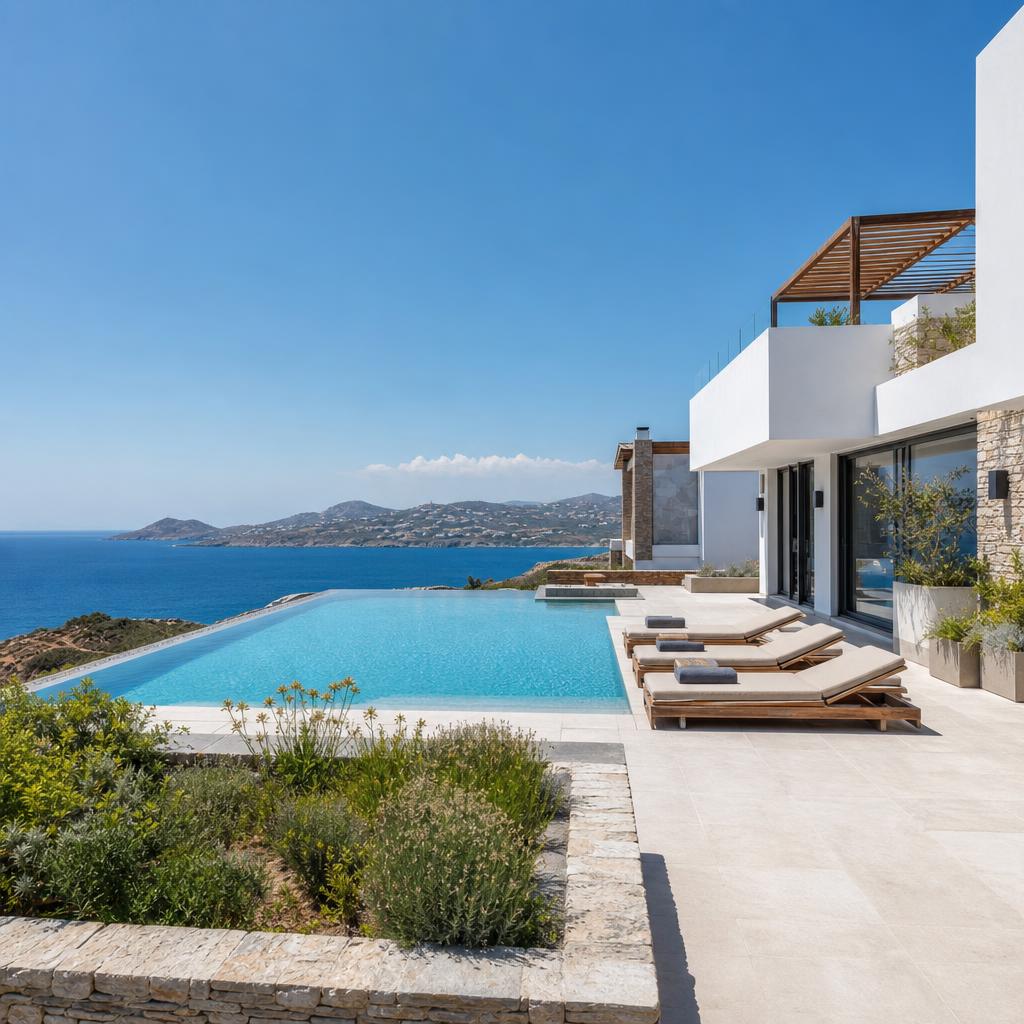
Crete offers exceptional value at this budget level. €980,000 buys serious quality on Greece's largest island — sea-view villas with pools in prime coastal positions, high-specification new-build apartments in Elounda or Agia Pelagia, and well-positioned properties in the characterful old towns of Chania and Rethymno. Crete's combination of infrastructure depth, extended season and relative value versus the Cycladic premium tier makes it particularly attractive for buyers prioritising yield returns over name recognition. See our villas for sale in Greece guide for current villa market analysis across the island.
Mykonos at this level is tight but not impossible for well-positioned town properties or hillside village houses. The island's rising entry costs mean that buyers seeking genuine premium positioning typically find themselves above the €1.2 million threshold. American buyers with Golden Visa objectives and flexibility on island destination often find that Santorini or Crete delivers stronger risk-adjusted returns at the €980,000 level than Mykonos.
The Golden Visa Dimension
A meaningful proportion of American buyers entering the Greek market are explicitly motivated — at least partly — by the Golden Visa residency pathway. The programme's €800,000 minimum threshold in prime areas including Athens, Santorini, Mykonos and Rhodes places the typical American buyer budget of €980,000 comfortably above the qualifying level in designated high-demand zones, and well above the €400,000 threshold applicable elsewhere in the country.
For Americans, the Golden Visa offers something with no direct equivalent in other accessible Mediterranean markets: a five-year renewable Greek residency permit that confers Schengen Area freedom of movement across 26 European countries. For buyers who travel frequently to Europe for business, have family connections to the continent, or are considering extended periods of European living, this mobility value is a material component of the total return calculation that meaningfully differentiates a Greek purchase from an Italian or Turkish alternative without EU access.
The visa is renewable indefinitely provided the qualifying property is retained, extends to the holder's spouse and dependent children, and can lead to permanent Greek residency after seven years of continuous physical presence. Our complete guide to buying property in Greece as a foreign national covers the Golden Visa process in full, including the documentation requirements and timeline for non-EU applicants.
Navigating the Purchase as a US Buyer
The Greek property acquisition process is navigable for American buyers, though it differs from the US real estate transaction model in several respects. The requirement for an AFM (Greek tax number), independent Greek solicitor representation and completion before a licensed Notary Public are standard features of every Greek transaction. US buyers should budget total acquisition costs of approximately 8–12% above the purchase price, covering transfer tax (3.09% on resale properties), notary and legal fees, and land registry costs.
Currency management is a practical consideration that is sometimes underweighted by buyers transacting from dollar-denominated wealth. Dollar-to-euro movements across a six-to-twelve month transaction timeline can meaningfully affect the effective dollar cost of a euro-denominated purchase at the €980,000 level. Forward contracts and currency specialists provide effective protection against adverse exchange rate movements between offer acceptance and completion — and for US buyers unaccustomed to currency risk on domestic transactions, this step is worth taking early in the process.
Our team works with American buyers at every stage of the acquisition process, from initial market orientation through to solicitor introduction, currency planning and post-completion letting management. Contact us to begin a conversation about the current market and the opportunities most aligned with your objectives and timeline.
The Broader Significance of American Buyer Demand
The arrival of American capital at scale — with average budgets of €980,000 — reflects a meaningful shift in how the Greek property market is perceived by sophisticated international buyers, and it has practical implications for all buyers competing in the same segments. American buyers at this price point are typically well-researched, financially credible and move decisively when they find the right property. Their concentration in Athens, the Cyclades and the premium new-build segment adds depth and liquidity to markets that were previously more dependent on European buyer cycles.
For British buyers — who remain among the largest and most established international buyer groups in Greece — the growth of the American market is positive for long-term asset values and resale liquidity. It broadens the secondary buyer pool for premium Greek assets and reinforces the international credential of the market. The combination of 71.1% documented price growth, 8.6% annual appreciation, yields of 5.1–6.8% and 32.7% off-plan uplift is a statistical profile that resonates equally whether the buyer's primary reference currency is dollars or sterling — and it is a profile that Greece's fundamentals appear capable of sustaining into the second half of this decade.
Considering property in Greece?
Speak with one of our London-based consultants for expert, tailored advice.
Contact Our Experts