Hotels for Sale in Greece: Hospitality Investment in a Global Tourism Powerhouse
Greece's hotel market combines global tourism demand, eurozone stability and genuine regional diversity — from Athens's year-round urban performance to the seasonal premium of Santorini and Mykonos. This guide covers every category, financial metric and due diligence step UK investors need.

Why Greece Is One of the World's Most Compelling Hotel Investment Markets
Greece is not simply a Mediterranean lifestyle destination — it is one of the world's most established and structurally resilient tourism economies. With over 33 million international arrivals recorded in 2024, Greece consistently ranks among Europe's top five most-visited countries, and that demand shows no sign of contracting. For investors evaluating hotels for sale in Greece, the opportunity extends well beyond real estate ownership: it is a structured entry into hospitality performance, brand positioning and long-term asset appreciation within a eurozone economy backed by decades of global tourism recognition.
Unlike many emerging markets where hotel investment carries significant demand-side uncertainty, Greece offers a proven and diverse visitor base — British, American, German, Middle Eastern, Australian — drawn by a combination of natural beauty, cultural heritage, world-class cuisine and a climate that supports an effective tourism season stretching from April through November in most regions, and twelve months per year in Athens and Thessaloniki. For experienced operators, private equity buyers and strategic investors, this is a market where real estate fundamentals and business performance genuinely align.
Structural Drivers of the Greek Hotel Market
Global Brand Recognition: Greece's tourism identity is among the most powerful in the world. Santorini's caldera sunsets, Athens' Acropolis, the beaches of Crete and the social atmosphere of Mykonos are universally recognised reference points that drive aspiration and repeat visitation from every major source market. This brand equity provides a structural demand floor that most hotel markets — even in established European destinations — cannot replicate.
Diversified Tourism Geography: Unlike smaller Mediterranean markets dependent on a single region, Greece offers genuine geographic diversity across its hospitality investment landscape. Mainland cities deliver corporate and cultural tourism. The Aegean islands provide aspirational seasonal demand at premium price points. Crete and Rhodes support large-scale resort operations alongside more intimate boutique models. The Ionian islands attract a different, often more loyal visitor demographic. This regional diversity allows investors to target specific risk-return profiles within a single national market.
Eurozone Stability and Regulatory Clarity: Greece operates within the European Union's monetary and regulatory framework, providing the legal transparency, financial predictability and contractual enforceability that sophisticated hotel investors require. Hotel transactions in Greece are governed by well-established corporate and property law, with improving digital infrastructure and accounting standards making due diligence progressively more straightforward.
Supply Constraints in Prime Locations: In the most desirable locations — particularly the Cycladic islands and coastal Athenian Riviera — planning restrictions and physical island geography severely limit new hotel supply. This structural constraint supports occupancy rates and average daily rates for existing well-positioned assets over the long term.
Key Hotel Investment Locations in Greece
Athens — Year-Round Urban Performance
Athens has undergone a remarkable transformation over the past decade, evolving from a gateway city into a destination in its own right. The Greek capital now attracts city-break visitors, cultural tourists, business travellers and cruise passengers in volumes that sustain twelve-month hotel occupancy — a structural advantage over the purely seasonal island markets. Key hospitality zones include the historic Plaka and Monastiraki districts, the premium Kolonaki neighbourhood, the rapidly developing Gazi and Metaxourgeio areas, and the emerging Piraeus waterfront.
Athens hotel performance metrics compare favourably with comparable Southern European capitals. Average daily rates for quality four-star boutique hotels in central Athens have risen consistently since 2018, and occupancy outside the summer peak has benefited materially from the growth in city-break tourism from Northern Europe and the expansion of direct flight routes. For investors seeking to reduce seasonal income volatility, Athens represents the most compelling entry point in the Greek hotel market.
Crete — Scale, Infrastructure and Operational Resilience
Crete is Greece's most significant single hotel market by volume, benefiting from international airports at Heraklion and Chania, an extended effective season from March through November, and a deeply established infrastructure of hotel management professionals, suppliers and service operators. The island supports the full spectrum of hospitality models: large all-inclusive coastal resorts anchored by international operators; mid-scale family-oriented beach hotels; upscale boutique conversions in the historic centres of Chania and Rethymno; and intimate luxury properties in quieter eastern and southern coastal locations such as Elounda, Plakias and Paleochora.
Crete's diversified visitor base — British, German, Scandinavian, Russian and increasingly American — reduces market concentration risk. The island's scale also supports genuine staffing depth and year-round operational viability in a way that smaller islands cannot match. For investors acquiring their first Greek hotel asset, Crete's infrastructure and market depth make it one of the most operationally manageable entry points in the country.
Santorini and Mykonos — Premium Seasonal Revenue at the Pinnacle
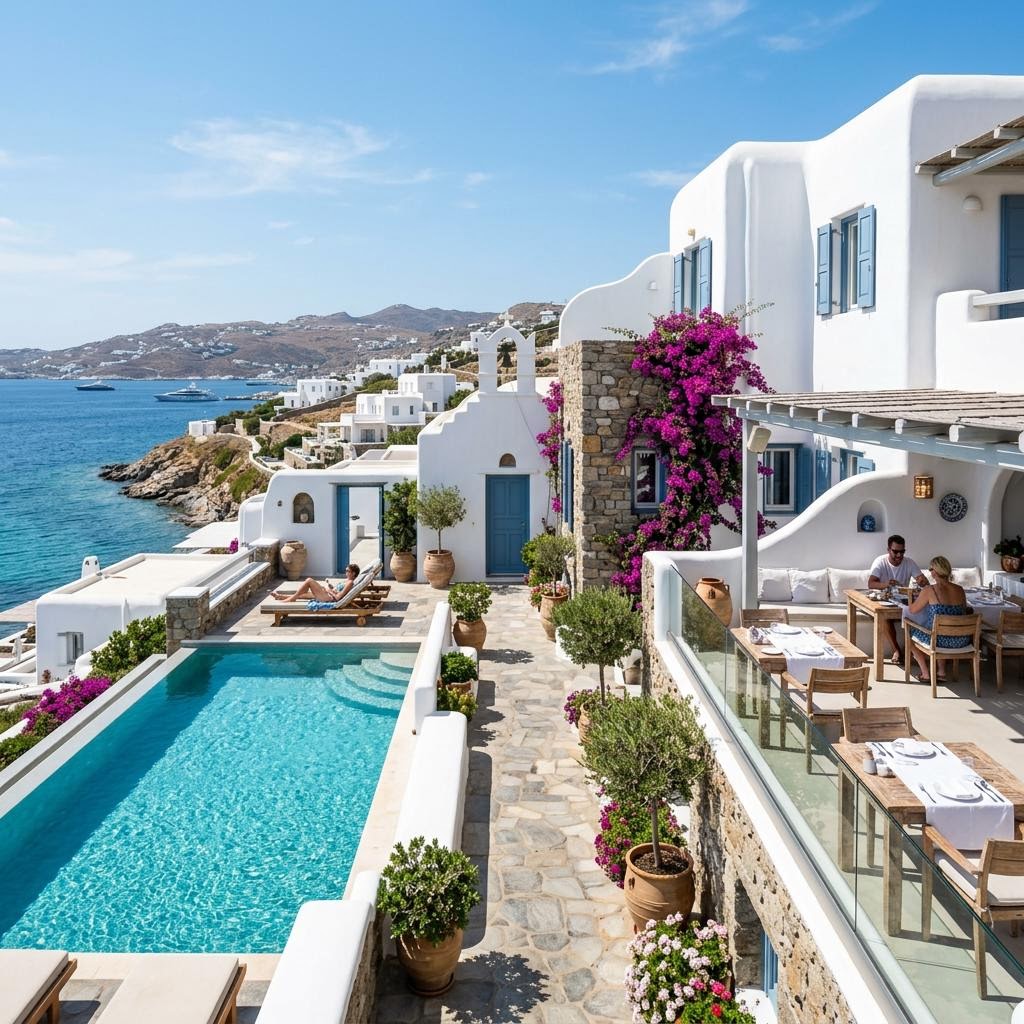
Santorini and Mykonos occupy the luxury apex of the Greek hotel investment market, and the performance metrics at the top end justify their premium acquisition costs. Exceptional boutique hotels in prime Santorini caldera positions — Oia, Imerovigli, Fira — achieve average daily rates of €400–€1,200 for standard rooms in peak season, with suites in trophy properties exceeding €3,000 per night. Occupancy in peak weeks (July and August) approaches 100% for well-marketed properties. Similar dynamics play out on Mykonos, where hotel ADRs are driven by the island's global reputation for luxury, entertainment and high-net-worth visitor concentration.
The challenge on both islands is seasonality: the effective high season runs 14–18 weeks, and investors must model realistic off-season scenarios carefully. For hotels that close entirely from November through March, total annual revenue is concentrated into an intense summer period, requiring strong cash flow management and accurate yield modelling. Properties with year-round viability — those able to attract shoulder-season guests through wellness programming, wine tourism or cultural offers — command meaningfully higher valuations.
Rhodes, Corfu and the Wider Island Network
Rhodes and Corfu represent an often-overlooked middle tier that offers genuinely attractive risk-adjusted hotel investment characteristics. Both islands have international airports, established British and Northern European visitor bases, diversified hospitality markets spanning budget to luxury, and entry prices considerably below the Cycladic premium tier. Rhodes in particular has seen growing investment interest as buyers priced out of Santorini and Mykonos seek comparable island exposure at lower capital commitments. The island's UNESCO World Heritage medieval old town and its extensive coastline support multiple distinct hospitality concepts within a single market.
Hotel Types and Investment Categories
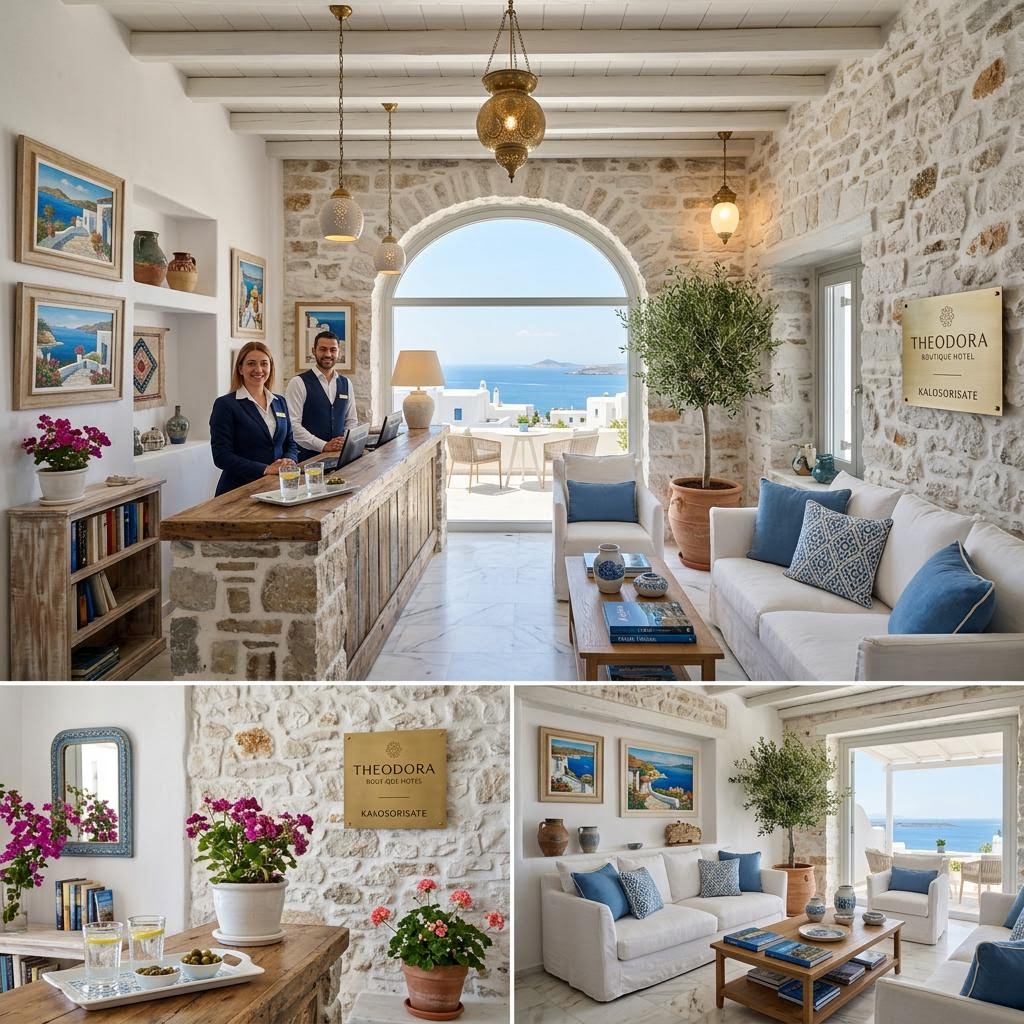
Boutique Hotels (10–40 rooms) are the most actively traded category in the Greek market among private investors and family offices. Located predominantly in historic island towns, seafront villages and premium coastal positions, boutique properties rely on design quality, unique guest experience and premium pricing to deliver strong RevPAR despite their scale. Acquisition prices range from €1.5 million for smaller mainland properties to €15 million or more for exceptional island boutiques in prime positions.
Mid-Scale and Resort Hotels represent the volume end of the market — larger properties with pools, restaurants, spa facilities and family-oriented services, typically operated under international management or franchise agreements. These assets require more capital but offer greater operational stability and more predictable cash flows. They are best suited to institutional buyers, experienced operators or PE-backed platforms with the management infrastructure to operate them efficiently.
Apartment-Hotel and Hybrid Models have grown in prominence as licensing frameworks have evolved. These structures — combining short-term lettable apartments with shared hotel services — offer flexibility in revenue generation and can accommodate mixed use across residential and hospitality purposes. They require careful legal structuring but can achieve strong blended yields in well-located urban and coastal settings.
Conversion and Repositioning Opportunities represent some of the highest potential return plays in the market. Historic buildings — Venetian mansions in Corfu, neoclassical townhouses in Athens, traditional stone properties in Crete's inland villages — can be acquired at relative discounts to purpose-built hotels and repositioned as premium boutique concepts, provided that planning permissions, structural costs and brand positioning are thoroughly assessed in advance. Speak to our team for introductions to specialist hotel transaction advisors who work across all of these categories.
Financial Metrics and Performance Evaluation
Hotel investment analysis requires a more sophisticated framework than residential property — and buyers who apply residential yield logic to hotel acquisitions consistently underestimate both the opportunity and the risk. The core performance metrics for Greek hotel evaluation are:
Average Daily Rate (ADR): The average revenue earned per occupied room per night. ADR is the primary pricing metric and varies enormously across Greek markets — from €80–€120 for a mid-scale Crete beach hotel in shoulder season to €500–€1,500+ for a premium Santorini caldera suite in July. Trend analysis of ADR over three to five seasons, cross-referenced against market comparables, is essential.
Occupancy Percentage: The proportion of available rooms occupied in a given period. Realistic occupancy modelling — not best-case scenarios — is critical to accurate income projection. A boutique Santorini hotel might achieve 95% occupancy in August but 10% in January. Weighted annual occupancy for Greek island hotels typically ranges from 45–70%, depending on season length and marketing capability.
RevPAR (Revenue per Available Room): The product of ADR and occupancy — the single most useful summary metric for hotel income performance. RevPAR allows comparison across properties of different sizes and locations. Buyers should request three to five years of audited RevPAR data as a baseline for income projections.
Gross Operating Profit (GOP) Margin: After accounting for all operating costs — staffing, utilities, maintenance, marketing, management fees and consumables — the GOP margin is what remains. Greek hotel operating margins vary widely but 25–40% GOP is a reasonable benchmark for well-run boutique operations in prime locations. Payroll is typically the largest cost line, and Greek labour law has specific provisions that must be understood before acquisition.
Due Diligence: What Hotel Transactions Require Beyond Residential
Hotel transactions in Greece are considerably more complex than residential property purchases, and buyers who approach them without specialist advisory support regularly encounter material surprises after signing. Beyond the standard property title search and planning compliance review, hotel due diligence must cover:
Hospitality licensing and regulatory compliance: Greek hotels must hold valid operating licences issued by the Greek Tourism Organisation (GNTO/EOT). Licence status, star rating classification, fire safety compliance and accessibility standards must all be verified as current and without outstanding enforcement actions.
Staff employment contracts and social security liabilities: Greek employment law provides strong worker protections. Existing employment contracts, collective agreements, outstanding social security contributions and potential redundancy liabilities must all be assessed as part of the acquisition process — particularly in share purchase transactions where employment liabilities transfer with the company.
Brand or management agreements: Properties operating under franchise agreements or third-party management contracts may have long-term commitments that materially affect the buyer's operational autonomy and exit flexibility. Review all such agreements carefully before commitment.
Online reputation and platform performance: Booking.com, TripAdvisor and Airbnb review scores, OTA commission structures and direct booking ratios are material indicators of revenue quality and marketing efficiency. Request platform-level performance data as part of the standard financial information package.
Transaction structure — asset vs share purchase: Many Greek hotel transactions are structured as share purchases of the operating company rather than direct property conveyancing. This approach can offer VAT advantages but requires thorough review of the corporate entity's historical tax compliance, any outstanding liabilities and the legal history of the operating company. Specialist Greek hospitality transaction lawyers are essential in either structure.
Value-Add and Repositioning Strategies
Greece's evolving tourism infrastructure and the growing international appetite for experiential, design-led boutique hospitality create genuine opportunities for investors willing to acquire and reposition underperforming assets. The most successful strategies typically involve one or more of the following approaches:
Refurbishment and design-led repositioning can transform a tired three-star property into a premium boutique concept commanding double the pre-renovation ADR, provided the location supports the upgraded positioning. Capital expenditure of €30,000–€80,000 per room is typical for a high-quality boutique refurbishment in Greece, depending on the extent of work and the existing structure.
Star rating reclassification — applying to the GNTO for an upgraded star rating following investment in facilities and service standards — can open access to higher-rated OTA platforms and improve brand perception in the luxury traveller segment.
Extending the operating season through wellness, culinary or cultural programming can materially improve annual RevPAR for properties currently constrained to a 16–18 week summer season. Properties that successfully attract shoulder-season guests at even modest occupancy can improve their annualised performance by 20–35%.
Legal Acquisition Framework for Foreign Buyers
Foreign nationals and corporate entities can acquire Greek hotels without significant restrictions, though the transaction process is more structured than residential purchases. The key steps are: engaging specialist Greek hospitality legal advisors for both property and corporate law dimensions; conducting full financial, legal and operational due diligence; structuring the transaction as either an asset purchase or a share transfer depending on tax and liability considerations; obtaining all necessary regulatory consents and GNTO licence transfers; and completing conveyancing or share transfer documentation before a licensed notary.
For buyers whose capital or risk appetite aligns better with the residential market, Greek villas in prime locations such as Santorini, Mykonos and the Athenian Riviera offer access to the same fundamental demand drivers — global tourism, supply constraint, eurozone stability — with lower operational complexity and management intensity than hotel ownership.
Currency and Capital Structure Planning
For UK buyers, the euro-denominated nature of Greek hotel acquisitions amplifies the importance of exchange rate management. Hotel transactions typically involve larger capital commitments than residential purchases, and sterling-euro fluctuations over a six-to-twelve month transaction timeline can materially affect the effective acquisition cost. Forward contracts, currency specialists and staged transfer strategies are all relevant tools for managing this exposure.
Financing structures for Greek hotel acquisitions may involve Greek corporate entities, international holding companies, project finance from Greek banks or EU-backed lending facilities. VAT structuring, corporate income tax planning and the implications of depreciation allowances on Greek real property are all areas where specialist Greek accountancy and tax advice is essential before finalising transaction structure.
Risk Considerations for Hotel Investors
Greece's hotel market is structurally strong, but disciplined risk assessment is non-negotiable before any acquisition commitment. The most significant risk factors to evaluate are: seasonality and cash flow management across the off-season period; emerging competitive supply in key locations (particularly mid-scale resort development on Crete and Rhodes); potential regulatory adjustments affecting short-term rental operations that could shift demand patterns between hotel and villa rental accommodation; local infrastructure capacity constraints during peak season on smaller islands; and exit liquidity — the depth of the secondary hotel transaction market varies considerably by location, asset type and price tier, and buyers should model realistic exit timescales before acquisition.
A rigorous feasibility study — incorporating realistic occupancy assumptions, accurate operating cost modelling and stress-tested downside scenarios — remains the most important investment protection available to any hotel buyer in the Greek market.
Who Is the Greek Hotel Market Right For?
Hotel acquisitions in Greece are best suited to four distinct investor profiles: experienced hospitality operators seeking European expansion with a credible tourism market and attractive asset pricing relative to Western European equivalents; private equity and family offices diversifying into tourism real estate within the eurozone, targeting repositioning upside or stable income generation; boutique lifestyle hotel brands seeking a Mediterranean market entry position in a destination with global name recognition and a deep premium traveller demand base; and entrepreneurial investors with renovation experience targeting conversion and repositioning strategies in well-located but underperforming assets.
For investors whose objectives are better served by lower operational complexity, the Greek residential market offers equally compelling access to the same fundamental demand drivers. Greek apartments in particular offer accessible entry points into the short-term rental market in Athens and across the islands, with substantially simpler management requirements and lower capital commitments than hotel ownership.
Conclusion: Real Estate and Business Performance in One of Europe's Strongest Tourism Markets
Hotels for sale in Greece represent a structured entry into one of the world's most proven and globally recognised tourism economies — offering investors a combination of real estate asset value, business income generation and long-term capital appreciation within the stability of the eurozone framework. The country's tourism diversity, supply constraints in prime markets and improving transaction infrastructure create a compelling environment for disciplined, well-advised hotel investment across multiple asset categories and price tiers.
Success depends on rigorous financial due diligence, operational expertise and strategic brand positioning aligned with realistic market analysis. Greece is not a speculative market — it is an established, mature and globally respected destination where hotel assets, when correctly selected and well-managed, can deliver both meaningful income and sustained capital performance over the long term. Our network of specialist hotel transaction advisors, legal professionals and hospitality consultants is available to support every stage of your acquisition process.
Considering property in Greece?
Speak with one of our London-based consultants for expert, tailored advice.
Contact Our Experts