Santorini vs Mykonos: Which Island Should You Invest In?
Two of Greece's most iconic islands each offer distinct investment profiles. This detailed comparison helps buyers decide which destination best matches their objectives, budget and risk appetite.

Two Islands, Two Investment Stories
Santorini and Mykonos are the two most globally recognised names in Greek island real estate. Both command premium entry prices. Both achieve exceptional nightly rental rates in peak season. Both attract a discerning international buyer base. Yet despite these surface similarities, the investment dynamics of the two islands are meaningfully different — and choosing between them requires a clear understanding of what each offers and what each demands.
This guide cuts through the lifestyle marketing and provides an honest comparison of the investment fundamentals: yield potential, capital appreciation prospects, buyer profiles, seasonality, liquidity and ownership practicalities. By the end, you should have a clear sense of which island better matches your specific objectives and budget.
Santorini: The Caldera Premium
Santorini's visual identity — the white-domed churches, the blue caldera, the volcanic cliffs of Oia — is among the most reproduced imagery in global tourism. This has created a near-universal demand signal that drives both visitor volume and buyer aspiration. The island hosts over 3 million visitors annually, many specifically drawn to the caldera villages of Oia, Fira, Imerovigli and Firostefani.
Property values in caldera-facing positions are among the highest per square metre of any location in Greece. Small cave houses and apartments with direct caldera views regularly trade at €1.2–€2.5 million. Modern villas in Oia with infinity pools and unobstructed sunset views command €3–€8 million and upwards for the most exceptional positions. Supply at the top end is structurally constrained by planning restrictions protecting the island's iconic skyline.
For investors, Santorini's rental ceiling is extraordinary. A well-positioned cave villa in Oia can achieve €2,500–€5,000 per night in July and August. Even with an effective peak season of 12–14 weeks, total seasonal revenue can exceed €150,000 for premium properties — implying gross yields of 8–12% at top-tier pricing.
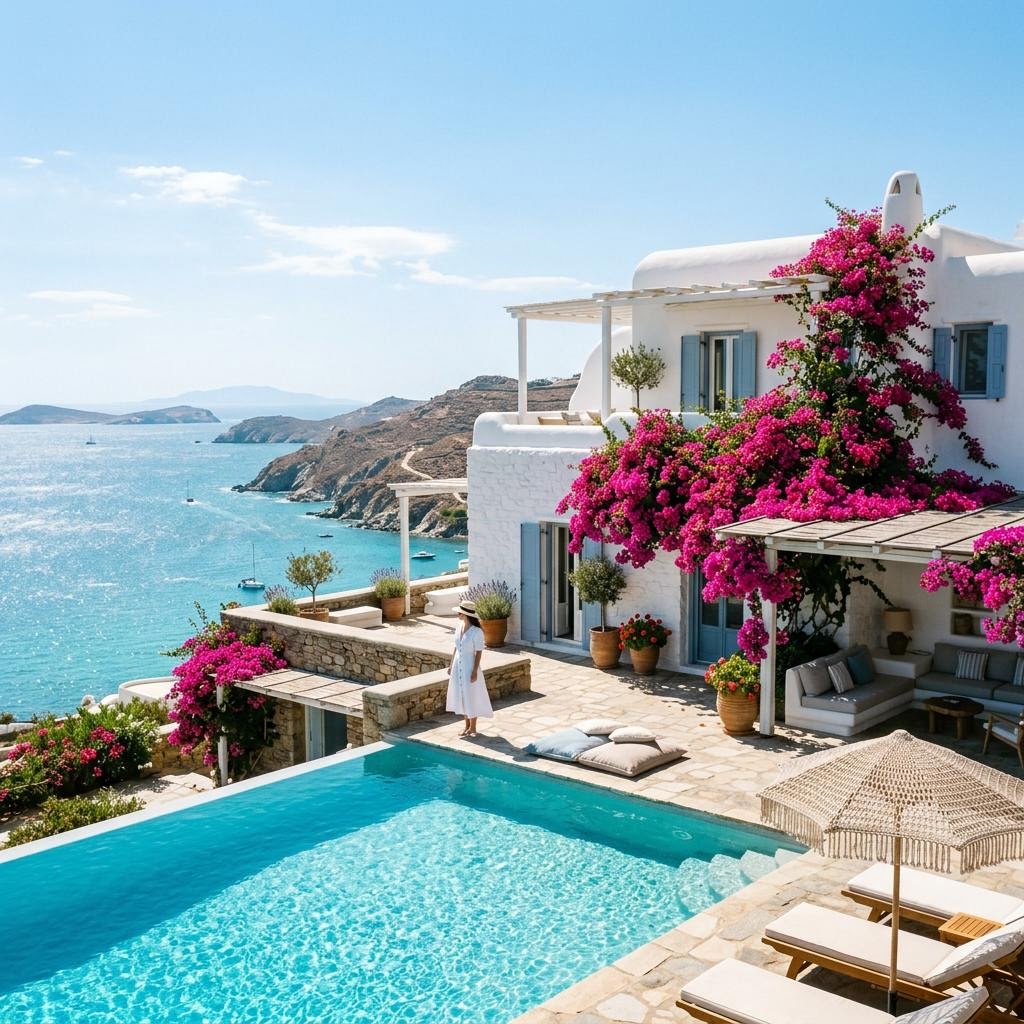
Mykonos: The Lifestyle Capital
Mykonos occupies a different position in the global consciousness. While Santorini is aspirational and romantic, Mykonos is energetic, social and fashion-forward. The island has established itself as the preferred destination for high-net-worth visitors from the US, Middle East, Russia and Europe — drawn by world-class restaurants, beach clubs, superyacht facilities and a festival atmosphere that runs from May through early October.
The Mykonos property market reflects this premium buyer demographic. Town houses and villas in Mykonos Town, on the beaches of Psarou and Ornos, or in the hills above Super Paradise command extraordinary prices — with top-tier properties routinely transacting above €5 million and exceptional compounds reaching €20 million or more. The island's construction land is broadly built out, and new high-quality supply is extremely limited, providing structural support for values.
Nightly rental rates on Mykonos rival Santorini at the top end. A five-bedroom villa with sea views and a pool will achieve €8,000–€15,000 per night in July and August. The effective rental season on Mykonos is longer than Santorini — typically late April to early November — improving total seasonal income and occupancy.
Comparing Entry Prices
At the premium end, both islands are broadly comparable. The meaningful differences emerge in the mid-market, where buyers evaluate value for money rather than chasing trophy locations. On Santorini, non-caldera villages such as Pyrgos, Megalochori and Akrotiri offer considerably more space per euro — and in some cases, genuine character renovation projects at prices well below €500,000. Mykonos has fewer such pockets; its market is more uniformly premium across the island.
For buyers with a budget of €500,000–€1.2 million, Santorini generally offers more options — though those options will typically not include caldera-facing positions. For buyers with €2 million or more, both islands offer genuinely exceptional property, and the choice comes down to lifestyle preference and investment strategy.
Seasonality and Rental Management
Seasonality is the most significant operational challenge for both islands. Santorini's effective high season runs from June to September — approximately 16 weeks. Outside this window, visitor numbers drop sharply, and properties that have not been fully let for the peak season face significant vacancy risk. Mykonos enjoys a slightly extended season — late April through October — giving a marginal advantage in total achievable occupancy.
Both islands require active, professional rental management. Licensing for short-term holiday lets under AADE requirements is mandatory, and property managers — typically charging 20–30% of gross rental income — are essential for most absentee owner-investors. Budget carefully for this cost before modelling net yields, as headline gross figures can be materially eroded by management fees and operating costs.
Capital Appreciation: The Long View
Both islands have delivered consistent capital appreciation over the long term, with only brief interruptions during the Greek crisis years. Prime Santorini caldera values have roughly tripled since their post-crisis lows. Mykonos's luxury villa market has seen similar or stronger performance — and in some micro-locations has outperformed Santorini on both pace and magnitude of appreciation.
The structural supply constraint on both islands — planning restrictions, island geography, limited buildable land — provides a credible medium-term floor beneath values. Demand is global and growing. The principal risk to capital values is a structural shift in Greek tourism patterns or a significant change in short-term rental regulation — risks that should be modelled in any serious investment case.
Liquidity: Can You Sell?
Resale liquidity on both Santorini and Mykonos is meaningfully better than on most other Greek islands, because the buyer pool is genuinely international rather than domestic. Properties priced correctly and marketed professionally — including internationally through specialist agencies — typically sell within 6–18 months in normal market conditions. Overpriced properties can sit considerably longer, highlighting the importance of accurate independent valuation at the point of purchase.
Which Island Is Right for You?
Santorini suits buyers motivated primarily by the iconic visual experience — the caldera, the sunsets, the architectural heritage — who accept a more compressed season in exchange for peak rental rates that reflect the island's unique global recognition. It also offers better value in the mid-market for buyers willing to look beyond the caldera villages.
Mykonos suits buyers who prioritise energy, social infrastructure and a premium hospitality ecosystem, and who have the budget to compete in a more uniformly elevated market. The longer effective season and deep-pocketed international buyer base support both rental income and resale liquidity.
For buyers whose budget sits below the Santorini or Mykonos premium tiers, it is worth exploring Crete's apartment and villa market, which offers excellent rental fundamentals, a longer season and significantly more accessible entry prices. Speak to our team for a tailored assessment based on your budget and objectives.
Final Verdict
There is no universally correct answer. Both islands are exceptional investment locations by any European comparative standard. The choice is ultimately a function of budget, investment horizon, personal taste and operational appetite. What we can say with confidence is that well-chosen, professionally managed property on either Santorini or Mykonos has historically rewarded patient investors with both income and capital growth. The question is not whether to invest — it is which island best serves your specific strategy.
Considering property in Greece?
Speak with one of our London-based consultants for expert, tailored advice.
Contact Our Experts